Expert Roof Insulation Across the UK
The roof is your home's first line of defence against the elements — and in an uninsulated or poorly insulated property, it is also the primary source of heat loss. Roof insulation addresses this directly, creating a thermal envelope that keeps warmth inside where it belongs and dramatically reduces the energy required to maintain a comfortable living temperature.
Roof insulation differs from simple loft floor insulation in that the insulating layer is positioned at rafter level — either between the rafters, above them, or below them — creating a "warm roof" in which the loft or attic space is within the thermal envelope of the building. This approach is essential for loft conversions, rooms in the roof, and any application where the loft space itself needs to be heated.
At Loft Insulations, we specialise in all types of roof insulation for residential and light commercial properties. Our team has the knowledge to specify and install the correct system for your property, whether that is a multi-layer foil between slim rafters, PIR boards for a flat roof warm deck, or a combination system for a challenging heritage building.
Get a Free Roof Survey
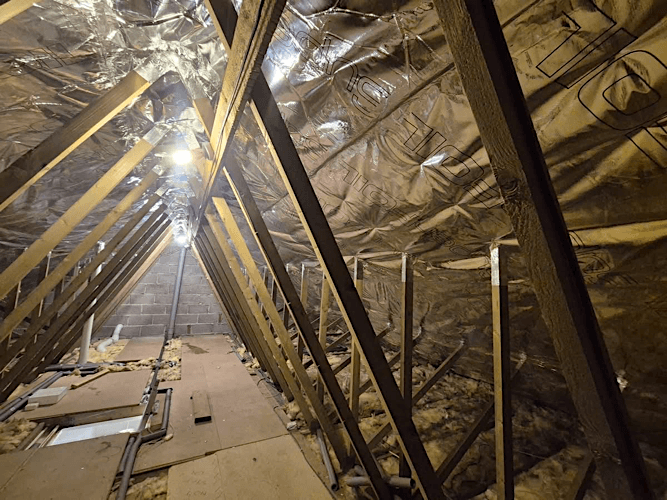

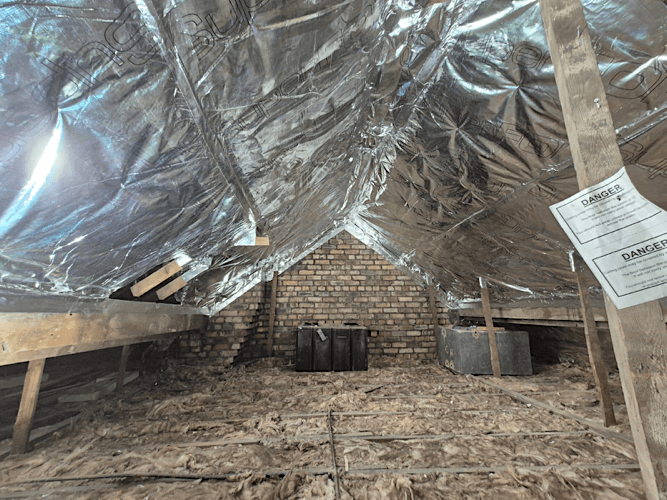
Pitched Roof Insulation Systems
For properties with a traditional pitched (sloping) roof, there are two main approaches to roof insulation — cold roof and warm roof:
Cold Roof (Loft Floor Level)
In a cold roof system, insulation is installed at ceiling joist level — the floor of the loft. The loft space above the insulation is cold and ventilated to the outside. This is the most economical approach for lofts not intended for habitation. Standard mineral wool, blown fibre, or SuperFOIL products can all be used.
Advantages: lower installation cost, straightforward access, and no change to the roof structure. Suitable for most standard residential lofts.
Warm Roof (Rafter Level)
In a warm roof system, insulation is installed between and/or below the rafters, bringing the roof space within the thermal envelope. This is essential for loft conversions and rooms in the roof. Products used include rigid PIR boards, SuperFOIL multi-layer foil, and combinations of both.
Advantages: keeps the loft space warm, prevents pipes and tanks from freezing, essential for habitable rooms, and can achieve very high U-values within the rafter depth.
Flat Roof Insulation
Flat roofs present a different set of challenges and opportunities for insulation. The two main approaches are:
- Warm Deck: Insulation placed above the structural roof deck, below the waterproofing membrane. This is the preferred modern approach as it keeps the structural timbers warm and dry, reducing the risk of condensation and timber decay. PIR boards or multi-layer foil products are typically used.
- Cold Deck: Insulation placed between the joists, below the roof deck. This approach requires very careful ventilation design to prevent interstitial condensation and is no longer recommended for most new installations.
- Inverted (Upside Down) Roof: Insulation placed above the waterproofing layer, protected by ballast or paving. Used primarily in commercial applications and extensively vegetated ("green") roofs.
Our team can survey your flat roof, assess the existing construction, and specify the appropriate insulation system to achieve the required U-value while managing condensation risk effectively.
Achieving Compliance with Building Regulations
All new roof insulation work in the UK must comply with Approved Document L (Conservation of Fuel and Power) of the Building Regulations. Current targets typically require:
- Pitched roof (cold): U-value ≤ 0.16 W/m²K
- Pitched roof (warm): U-value ≤ 0.18 W/m²K
- Flat roof: U-value ≤ 0.18 W/m²K
Achieving these values requires careful product selection and installation design. Multi-layer foil products used by our team are independently assessed for compliance, and we provide all necessary documentation to support your building regulations application.
For permitted development work where no formal approval is required, we still recommend designing to current standards to maximise the performance benefits of your investment.
Heritage Buildings and Listed Properties
Roof insulation in listed buildings or within Conservation Areas requires careful consideration of planning constraints. Some insulation methods — particularly those that alter the external appearance or structural fabric of the building — may require Listed Building Consent or Conservation Area Consent. Our team has experience working within these constraints and can advise on appropriate solutions that respect the character of your property while improving its thermal performance.
Why Roof Insulation Is a Sound Investment
Unlike some home improvements, roof insulation delivers measurable financial returns from day one. A well-insulated roof reduces heat loss, which directly reduces your heating bills. Depending on the starting condition of the property and the type of insulation installed, payback periods of between 2 and 7 years are typical for residential roof insulation projects.
Beyond the direct financial saving, a higher level of roof insulation improves your property's EPC (Energy Performance Certificate) rating, which is increasingly important for property valuations and is now a legal requirement for privately rented properties to meet minimum standards. Properties with better EPC ratings command premium prices and are more attractive to buyers and tenants alike.
If you are considering a loft conversion, proper warm roof insulation at rafter level creates a thermally comfortable habitable space that adds significantly more value than the conversion cost alone. Our team can advise on the optimum insulation specification for conversion projects, working alongside your architect or builder to achieve the best possible result.