
When homeowners ask us about loft insulation, one of the most frequent questions is: "What's the difference between SuperFOIL and standard mineral wool — and which should I choose?" It's a great question and the answer depends on your specific situation. In this guide, we explain both products honestly and help you decide which is right for your home.
What Is Mineral Wool Loft Insulation?
Mineral wool is the traditional loft insulation product that most people think of when they imagine insulating a loft. Available in two main forms — glass wool (made from recycled glass) and rock wool (made from volcanic rock) — it works by trapping millions of tiny pockets of still air within its fibrous structure, which slows the conductive transfer of heat.
For a standard cold loft, mineral wool is laid between the ceiling joists and then a second layer is laid at 90 degrees across the top of the joists. The recommended total depth is 270mm, which achieves a U-value of approximately 0.16 W/m²K — the current UK Building Regulation target for cold loft insulation.
Mineral wool is widely available, well understood by building control inspectors, and reasonably priced. It is the most common loft insulation product in the UK by a significant margin. However, it is not without limitations.

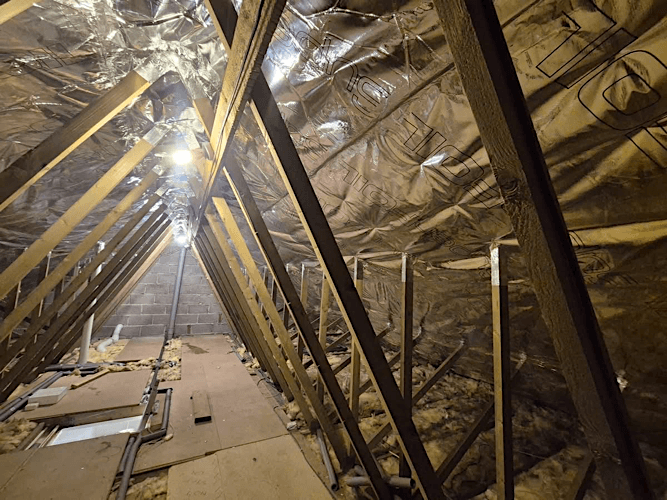

What Is SuperFOIL Insulation?
SuperFOIL is a family of British-manufactured multi-layer foil insulation products. Unlike mineral wool, which relies entirely on trapped air for its insulating properties, SuperFOIL products combine multiple layers of highly reflective aluminium foil with layers of insulating wadding to address all three modes of heat transfer: radiation, conduction, and convection.
The product is supplied in rolls and is lightweight, clean, and free from irritant fibres. It can achieve the same or better thermal performance as mineral wool in a fraction of the thickness — typically 25–40mm compared to 270mm for mineral wool.
Head-to-Head Comparison
| Factor | Mineral Wool | SuperFOIL |
|---|---|---|
| Typical thickness needed | 270mm | 25–40mm |
| Radiant heat control | ❌ None | ✅ Excellent |
| Summer cooling effect | ❌ Poor | ✅ Good |
| Vapour control | Separate product needed | Integrated option available |
| Ease of installation | Moderate (heavy, itchy) | Easy (clean, lightweight) |
| Cost (approx. per m²) | £2–£5/m² | £8–£18/m² |
| Low loft height suitability | ❌ Poor | ✅ Excellent |
| Lifespan | 40+ years (may compact) | Lifetime of building |
| Building Regs compliance | ✅ Yes | ✅ Yes (when BBA certified) |
When Should You Choose Mineral Wool?
Mineral wool remains an excellent choice for standard cold loft floor applications where:
- There is plenty of joist depth available (at least 100mm between joists)
- The loft has reasonable access and is relatively straightforward in shape
- Budget is the primary consideration
- The loft space does not need to be used for storage or access
In these circumstances, mineral wool delivers reliable, cost-effective thermal performance and meets Building Regulations requirements without difficulty. It is the product we install most frequently for straightforward residential loft insulation projects.
When Should You Choose SuperFOIL?
SuperFOIL comes into its own in a number of situations where mineral wool falls short:
- Low loft height or shallow rafter depth: If there is insufficient depth for 270mm of mineral wool, SuperFOIL achieves the same thermal performance in as little as 25mm.
- Loft conversions: Warm roof insulation between rafters almost always demands a thin-profile product. SuperFOIL is ideal.
- Warm roof applications: Any situation where the insulation goes at rafter level rather than loft floor level benefits from SuperFOIL's superior radiant heat control.
- Summer comfort: If overheating in the room below the roof is an issue, SuperFOIL's radiant barrier properties help keep the space cooler in summer.
- Clean installation: Where there is a concern about dust, fibres, or mess — common in occupied loft conversions.
Our Recommendation
There is no single "best" loft insulation — the right product depends on your specific property, loft type, and performance goals. Our free survey service is designed precisely to help you make the right choice. We will assess your loft, explain the options honestly, and recommend what we genuinely believe is best for your home and budget — not what generates the highest margin for us.